


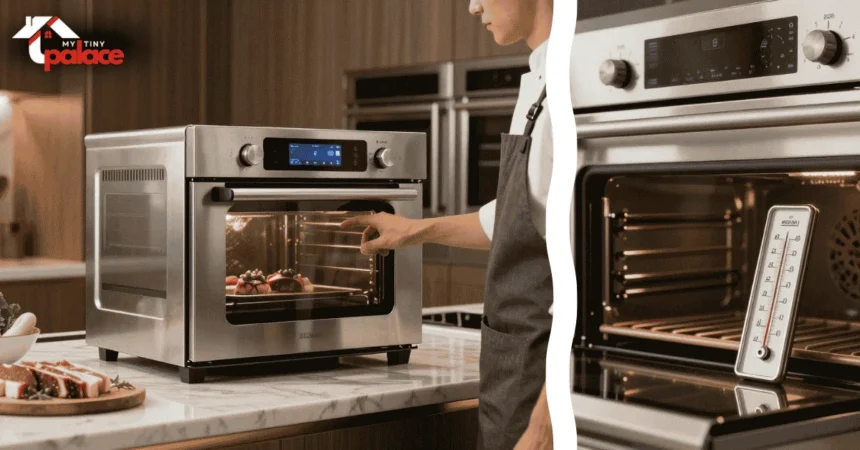
Getting professional cooking results at home starts with precise heat control. Your cooking gear must match the digital settings for perfect roasting and baking.
Calibrating your device keeps your investment in top shape. This easy step ensures every dish meets your high standards of quality and precision.
Modern luxury kitchens need perfect consistency. By keeping your oven in check, you get the exact heat for complex recipes. Knowing how to adjust these settings boosts your cooking skills and confidence.
Why you must calibrate smart oven appliances for professional results
Did you know your oven’s temperature might not match the digital display? Many people think a new oven is always accurate. But your oven could actually be at a different heat level than shown on the screen.
This means your appliance might need calibration to match your settings. If it’s running hot, your pastries could burn before they’re done. Struggling to get consistent results across recipes is a sign that it needs calibration and possibly a new thermometer in the oven.



To calibrate your oven correctly, first spot the signs of an off thermostat. If your food isn’t evenly browned, it’s a sign of bad heat distribution. You’ll likely need to calibrate your oven to solve these issues.
Calibrating your oven is key for any serious home chef. Learning to calibrate your equipment lets you control your cooking. A well-calibrated oven ensures you get perfect results every time you bake.
Preparing your kitchen for accurate temperature verification
To get professional results in the kitchen, you need to prepare for precise temperature checks. First, pick a high-quality oven thermometer for accurate heat measurement. It doesn’t matter if you have a gas or electric wall oven; a reliable tool is key.
Always check your owner’s manual before you learn how to calibrate your oven. It has specific instructions for your model, especially for convection or broil settings. These guidelines help you avoid mistakes when checking your oven’s temperature.
Related Articles

Proper placement of the thermometer on the center rack
To get an accurate reading, place a rack in the oven’s center. This spot in the center of the oven ensures even heat distribution during your test. Then, put your thermometer on the rack to capture the ambient heat correctly.
After setting up the thermometer and closing the door, let the oven preheat fully. This step is crucial to test the oven’s temperature without the initial heating cycle’s interference. By doing this, you create the best environment to calibrate your oven and ensure it works as expected.
How to calibrate your oven temperature using digital controls
You can easily calibrate your oven temperature with the digital control panel. Modern appliances let you adjust the temperature through an internal settings menu to help you calibrate the oven accurately. First, check your owner’s manual for the steps for your model.
To start, press and hold two buttons at once or use specific menu prompts to enter calibration mode. In this mode, you can change the temperature in small steps, like 15° F, to help calibrate the oven for perfect recipe matching.
Before adjusting, test the oven’s temperature to see the current offset and determine if you need to calibrate the oven. Place a reliable thermometer in the oven’s center on the middle rack. Preheat it and wait for it to stabilize before checking the temperature.
If the thermometer in the oven shows a difference, use the arrows to adjust the temperature on your display. Whether you need to increase or decrease the temperature, these controls make it easy to calibrate the oven. Calibrating your oven is key to consistent results in baking or roasting.
Saving your settings for consistent results
After calibrating your oven’s temperature, save your changes. Most digital interfaces will ask you to confirm the adjustment before leaving the menu. Not saving can cause the oven to go back to its old settings, leading to uneven cooking.
By following these steps, you can adjust your oven’s temperature to meet your needs. This digital method is the most reliable for keeping your oven in top shape for convection baking or broiling. Regular maintenance ensures you get great results for all your favorite dishes.
Manual adjustments for analog and older oven models
Even with older ovens, you can still bake like a pro. These units use analog controls, but you can still get even cooking. Unlike newer ovens, you’ll need to touch the controls physically.
To start, you’ll need to open the thermostat housing behind the knob. You’ll loosen sthe crews on the back of the knob. Then, you can adjust the temperature to your liking.
Making an eighth of a turn for subtle shifts
If your oven is too hot, turn it counterclockwise to cool it down. To cook dishes faster, turn them clockwise. Remember, only turn it an eighth of a turn at a time.
Even a small turn can change the oven’s temperature a lot. It can go up or down by 15° F. Always check the temperature after each adjustment. Being patient is key to getting the oven just right.
Troubleshooting common calibration challenges
Even the most advanced wall oven can face issues over time. If your oven’s heat isn’t steady, it might be a sensor or mechanical problem. Knowing this early can save your meals.
Verifying the integrity of the oven door seal
The oven door is key to keeping heat inside. Check the gasket around the oven window for wear, cracks, or gaps. If it’s damaged, heat gets out, making it hard to keep the temperature.
Checking these parts is crucial before adjusting the oven. If the seal looks good, try baking without a thermometer. But a reliable oven thermometer is best for accuracy when calibrating an oven.
Adjusting controls needs precision. For small adjustments, you might need to turn screws on the back. A small turn can change the oven’s heat settings a lot.
If the temperature keeps changing, the sensors might need to be replaced. Don’t try to fix it yourself, as it could be dangerous and affect the oven calibration. Call a certified technician for repairs. If your oven’s not working right, a pro might need to calibrate it for safety and good results.
Conclusion
Getting restaurant-quality meals starts with your kitchen’s appliances. A well-set oven is key to every recipe’s success.
You should get the same results every time you bake or roast. If your food is evenly browned, your equipment is working right, indicating that the oven may not need calibration.
Check your oven door for gaps or loose seals. A clear window lets you watch your food cook without losing heat.
Maybe your oven doesn’t heat as well as it used to. A few tweaks can make it work like new again.
If your oven’s temperature keeps changing, call a certified technician. They’ll keep your kitchen creative and growing.
Keeping your appliances in good shape saves you money in the long run. Enjoy a kitchen ready for any cooking challenge.