





When people picture a luxury outdoor garden, they imagine mature trees, sculpted water features, natural-stone pathways, and boulders that look as if they’ve rested in that spot for a hundred years. What most people don’t picture is the crane parked on the street, the rigging crew coordinating hand signals, or a chain hoist inching a six-ton limestone monolith into position, millimeter by millimeter. Yet none of that finished beauty is possible without serious lifting equipment and the specialized riggers who operate it.
- What Defines a Luxury Outdoor Garden?
- Large Landscape Boulders That Create a Natural Focal Point
- Planting Mature Trees for an Instantly Established Landscape
- Installing Pergolas, Gazebos, and Garden Pavilions
- Adding Water Features Without Compromising Your Landscape
- Positioning Oversized Planters and Garden Sculptures
- Building Outdoor Kitchens and Entertainment Areas
- Why Professional Rigging Is Essential for Large Garden Installations
- Heavy Lifting and Rigging Equipment Used for Luxury Garden Projects
- Planning Your Luxury Outdoor Garden from the Ground Up
- Bringing Your Luxury Outdoor Garden Vision to Life
What Defines a Luxury Outdoor Garden?
A luxury outdoor garden isn’t defined by square footage alone. It’s defined by scale, permanence, and the impression that everything has always belonged there. That means mature trees instead of saplings, full-grown boulders instead of decorative gravel, and structures built to feel like part of the land rather than additions to it. These elements can weigh anywhere from a few hundred pounds to well over ten tons, which immediately separates luxury garden construction from typical residential landscaping. You simply cannot muscle materials like this into place with a shovel and a wheelbarrow.
Large Landscape Boulders That Create a Natural Focal Point
Oversized boulders are among the fastest ways to give a garden a sense of age and grandeur. A single feature boulder for a water garden or entry courtyard can weigh more than a small car. Setting it so it looks naturally embedded, rather than dropped in place, requires careful crane work and riggers who understand how to read a boulder’s center of gravity before it ever leaves the ground.
Planting Mature Trees for an Instantly Established Landscape
Homeowners investing in a luxury garden rarely want to wait fifteen years for a tree to mature. A large specimen oak with its root ball intact can weigh more than 8,000 pounds. Lifting and transplanting a tree this size requires cranes capable of slow, controlled movement, along with tree-specific slings that cradle the root ball without damaging roots or crushing bark during the move into the ground.



Installing Pergolas, Gazebos, and Garden Pavilions
Many luxury gardens now include prefabricated structural elements, such as timber pergolas, stone-clad gazebos, or fully built garden pavilions, delivered to site as complete units rather than assembled piece by piece. Setting these structures level and square, often over finished hardscaping that can’t be damaged, requires equipment that can lift smoothly and hold a load steady while crews make fine positional adjustments.
Adding Water Features Without Compromising Your Landscape
Waterfalls built from stacked boulders, koi ponds with structural liners, and infinity-edge reflecting pools all rely on the precise placement of heavy components. The boulders used to build a natural-looking waterfall are often selected for their shape and set in a sequence that mimics natural erosion. Getting that placement right without disturbing surrounding plantings or existing hardscaping is one of the most technically demanding parts of a luxury garden build.



Positioning Oversized Planters and Garden Sculptures
Large stone or cast planters, fountains, and garden sculptures are often as much art installations as landscaping elements, and they’re frequently the heaviest single pieces on a site. Positioning them precisely, sometimes on elevated terraces or over structural decking, requires equipment that can lift with control and set the piece exactly where the designer intended, with zero margin for a damaging drop.
Building Outdoor Kitchens and Entertainment Areas
Outdoor kitchens with stone countertops, built-in grills, and masonry surrounds involve setting heavy prefabricated components, including stone slabs, precast counters, and structural islands, into place, often in confined spaces near the home. Lifting equipment allows these heavy pieces to be maneuvered into tight courtyards and patios without damaging nearby structures or landscaping.
Why Professional Rigging Is Essential for Large Garden Installations
None of the work described above can be done safely without professional rigging. Reputable landscape contractors work with certified riggers and crane operators who calculate load weights, check ground bearing capacity before setting outriggers, and inspect every piece of rigging gear before a lift begins. For a homeowner spending significant money on a garden meant to last decades, this attention to safety protects not only the crew but also the finished landscape itself. A dropped boulder or a snapped root ball can undo months of design work in seconds.
Heavy Lifting and Rigging Equipment Used for Luxury Garden Projects
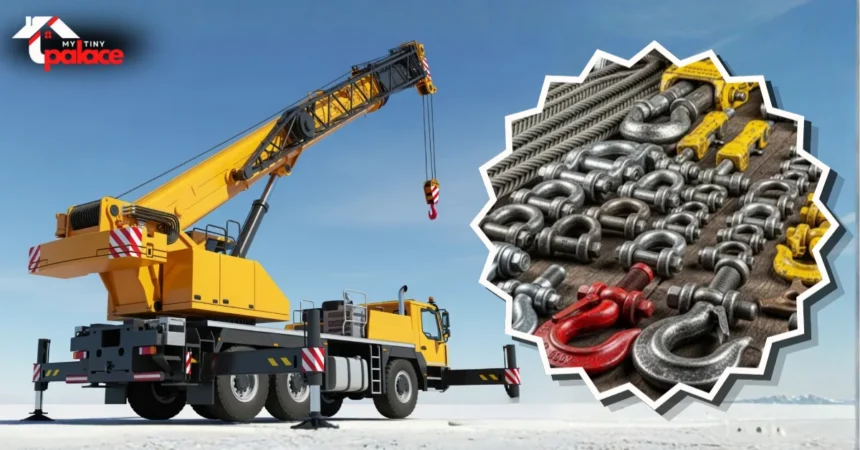
Cranes get most of the credit, but the rigging equipment is what actually keeps everything under control during a lift. Tools that show up frequently on these job sites include:


Mobile and knuckle boom cranes. Knuckle boom cranes are especially popular because their articulated arm can fold and extend around fences, power lines, and rooflines, a feature that is critical on tight residential lots.
Nylon and tree slings. Wide, flat nylon slings distribute weight evenly around a boulder or trunk. Cradle-shaped tree slings cinch securely around a root ball without slipping.
Spreader bars. For long or awkwardly balanced loads, such as a wide precast fountain basin, spreader bars keep the sling angles wide enough to avoid overloading the rigging and prevent tipping.
Chain hoists (chain falls). Once a heavy element is roughly positioned, a manual chain hoist allows crews to make fine adjustments, nudging a boulder an inch or leveling a stone bench without re-engaging the crane.
Shackles. Screw-pin and bolt-type shackles connect slings to the crane’s hook or to spreader bars and are sized to the working load limit required for that specific lift.
Come-alongs (ratchet lever hoists). Portable, hand-operated hoists used to pull materials into tight final positions, such as sliding a heavy stone slab flush against a retaining wall.
Tag lines. Rope lines attached to a suspended load allow ground crew to guide it and prevent dangerous spinning while it’s still in the air.
Planning Your Luxury Outdoor Garden from the Ground Up
Because so much of a luxury garden depends on heavy elements, planning must start with logistics, not just design. Site access for a crane, overhead clearance, ground stability for outriggers, and delivery sequencing all need to be worked out before a single boulder or tree is ordered. Designers who understand rigging constraints early can plan layouts that are achievable on site, rather than discovering mid-project that a key feature can’t be reached or safely lifted into place.
Bringing Your Luxury Outdoor Garden Vision to Life
A luxury garden is ultimately a feat of coordination between design vision and heavy-equipment expertise. Cranes provide the muscle, but slings, shackles, spreader bars, chain hoists, and tag lines provide the control that turns an ambitious plan into a finished space that feels effortless, natural, and entirely permanent. Working with a landscape team that understands both sides of that equation is what separates a garden that merely looks expensive from one that’s genuinely built to last.